The transition to the 20th century: the birth of "dowsing"
Two figures born in the late 19th century will push this art to its peak.
Abbé Alexis Bouly (1865 – 1958)

To the exact opposite of Paramelle's purely scientific approach, Abbé Alexis Bouly (1865-1958), parish priest of Hardelot in Pas-de-Calais, put everything on physical sensitivity. It is he who, by combining words Radius (ray) and aisthesis (sensitivity), invents the universal term " dowsing".
For him, the human body functions as a receiver capable of capturing the "waves" or "radiations" emitted by the moving water. During the First World War (1914-1918), his talent was to attract the attention of the staff of the French army, faced with the terrible war of the trenches.
The army will use Abbé Bouly and his pendulum for critical military missions:
- Detection of enemy sappers: In the underground war, German soldiers dug galleries under the French lines to place tons of explosives there. Abbé Bouly, walking above the lines, managed to locate the route of enemy galleries under construction by feeling the vibrations of vacuum and human activity in the basement.
- Search for unexploded shells: After the bombings, many shells sank deep into the mud without exploding, representing a deadly danger to the troops. Bouly used his pendulum as a primitive "metal detector" to map buried ammunition.
- The supply of water to troops: Finding drinking water near the front for thousands of soldiers (and horses) without attracting enemy artillery attention was a matter of life or death. Bouly identified priority drilling points.
After the war, his contribution was so respected that he was appointed Knight of the Legion of Honour in 1950 for his services to science and the homeland.
Abbé Alexis Mermet (1866-1937)
Remote or cartographic dowsing
Abbé Alexis Mermet remains a must-see figure in dowsing. Nicknamed the Prince of the Sourcers, this French Catholic priest was able to raise the ancestral practice of the wand to the rank of a rigorous, almost scientific method, fascinating his contemporaries by the accuracy of his results.

A legacy and a vocation
Born on November 12, 1866 at the Ollières in Haute-Savoie, Alexis Mermet bathed very early in this mysterious art. Son of the greatest alpine scholar of the 19th century, Jean Mermet, he inherits this gift which he refines throughout his life as a Churchman. He was a chaplain in Rolle, canton Vaud and Jussy, canton Geneva, Switzerland. For him, the dowser was not a wise man, but a person with a special sensitivity to capture certain radiation emitted from the basement. Radiation emitted from groundwater sources thus has a characteristic energy that can be captured by a receptor, in this case the human brain that functions in the same way as a radio, the antenna being the pendulum or a rod that will react when it encounters the corresponding desired wave.
His reputation in this field dates back to his participation in a dowsing competition organized as part of the second experimental psychology congress in March 1913 in Paris.
"How I Operate": The Wizard's Bible
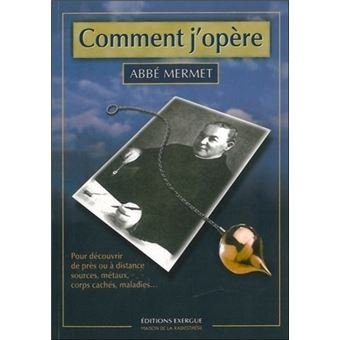
In the first third of his book, "How to work", published in 1936, he explained in detail his method, while the last two thirds of the book consisted of a hundred letters written between 1931 and 1934 to thank him most often for his discoveries of mineral water from underground rivers. His book How I operate, became a reference manual for generations of dowsing.
Remote or cartographic dowsing
What makes Abbé Mermet captivating is the seriousness with which he approached his art. He was looking for physical explanations of what he perceived, trying to get the dowser out of the realm of pure superstition. His interventions, which were successful in water research, earned him global recognition and a reputation for "genius misunderstood" against an official science that remained sceptical.
A little child who had disappeared in Valais, his uncle contacted Abbé Mermet. The Abbé made two crosses on a map, stating that the child had been abducted in the air and sent the card to that uncle. Once, in the past winter, the man and some relatives went to the mountain to the place of the first cross where they found a small shoe and on a steeper area, the bones of the child who had been removed by an eagle.
Until his death in 1937, he continued to practice, leaving behind him an indelible trace in the history of dowsing. His legacy remains, and his works are still reissued today, testifying to the enduring fascination of this priest who "read" the secrets hidden under the earth.
One of Abbé Mermet's greatest achievements was the perfection of remote dowsing, also known as cartographic dowsing. By holding the pendulum above maps, city plans or building foundations, he managed to accurately locate groundwater veins.
Henry Vincenot (1912 – 1985)

In the literature, it is precisely this figure of the old parish priest or the marginal connected to the "veines of the earth" that inspired Henri Vincenot to create his character from La Gazette. In his famous local novel Le Pape des Snails (1972), Henri Vincenot places water at the heart of a double symbolic: mystical and ecological. The central character of La Gazette (the "water finder", a magnificent wandering and beggar prophet) uses this element to guide the young sculptor Gilbert, while delivering a plea of surprising modernity.
Here are the main axes of the theme of water in his novel:
Sacred and Druid Water: The "Lady of the Underworld"
For Henri Vincenot, deeply attached to the Celtic and educational roots of his native Burgundy, water is not only a chemical compound; It is a spiritual entity.
The Gazette dedicated a cult to what it calls the "Lady-de-subterre", a divine personification linked to the deep groundwaters, which greatly recalls Sequana, the Gallo-Roman goddess of the sources of the Seine.
The gastropode, which gives its name to the title, is the water animal par excellence: it only comes out in rain, advances to the rhythm of nature and draws on its shell a spiral, a Celtic symbol of the energy flows of the Earth and life. Groundwater is the matrix energy of the world.
A pioneering ecological intuition
Written in the early 1970s, the novel shows a fulsome ecological premonition about water pollution.
Denunciation of agricultural chemistry: When the peasants complain to La Gazette that the sources dry up in summer or become unsanitary, the old chemineau sends back their own responsibility in a crazy way. He denounces the intensive use of "superphosphates", nitrates and sulphates that poison the earth and infiltrate the tablecloths.
Vincenot rebelled against the death of small village fountains and the decline of a harmonious lifestyle in favour of blind productivism.
Water against stone: artistic inspiration
Water also plays a key role in Gilbert's artistic awakening, the young peasant gifted for sculpture.
It is by observing the water flowing from monumental fountains and listening to the murmurs of the springs hidden in the Burgundy forest that the young man learns to feel the "vibration" of the stone.
Water serves as an organic link between men, builders of the Middle Ages and the bowels of the soil. She purifies Gilbert's spirit from the artificial and corrupting temptations of the city (Paris) to bring him back to the true meaning of his Earth art.
In short, the water at Henry Vincenot's is the blood of the Earth. To defile it or to forget its sacred character is, for humanity, to cut off the vital link between it and its origins.
With the industrial revolution, the meaning of the water source evolves from a sacred status to a major economic and strategic resource.
Mechanical energy and electricity: Watermills, then hydroelectric dams, have transformed rivers into industrial engines.
Thermalism (19th century): Water cities (Evian, Vichy, Baden-Baden) rediscover the therapeutic virtues of thermal springs. Water becomes a luxury and health product, giving birth to the bottled water industry.
(Cf. underground river Tab)
Verne Cameron (1896-1970) — United States
He was a well-known Californiar in America and specialized in the search for high-flow water wells for farmers.
He invented the "Aurameter" (a dowsing tool combining pendulum and wand).
The submarine incident (1961)
At that time, Verne Cameron's reputation as a dowser and inventor of the Aurameter crossed the borders of California. He states that his tool not only detects source water, but can map any water mass or disturbance, even remotely on a map.
To prove the effectiveness of his method, Cameron was invited by U.S. Navy officials to demonstrate on board a ship. We'll show him a map of the Pacific Ocean.
By flying over the map with his Aurameter, Cameron began to point precise coordinates in the middle of the ocean. He states that his tool feels the presence of moving metal masses.
To the surprise of the officers present, the points indicated by Cameron correspond exactly to the secret positions of the U.S. submarine fleet, then on a confidential mission. Even more serious, he points to other coordinates by saying that they are Soviet submarines tracking American ships.
The paranoia of the Pentagon and the CIA
The US government classifies Verne Cameron as a "risk to national security." His passport was withdrawn to prevent him from travelling abroad. The CIA and the Pentagon fear above all that they will go to the USSR and that the Soviets will use their talents and the Aurorater to locate and destroy the American submarine fleet.
The trigger for this travel ban was an official invitation from the South African government, which wanted to hire Cameron to help him locate huge groundwaters in its drylands.
This incident remained engraved in the history of dowsing as the moment when a simple spring tool, originally designed to find water for farm wells, shook the secret services and army of the world's largest military power.

Cameron's great strength, according to his supporters, lay in his ability not to simply say "there is water," but to quantify the resource. Even before the drill attacked the ground, it claimed to be able to predict the exact depth of the aquifer rock and the precise flow rate measured in gallons per minute. His clients' records show many correspondence from the time that Cameron's predictions were accurate within a few metres.