Mesopotamia
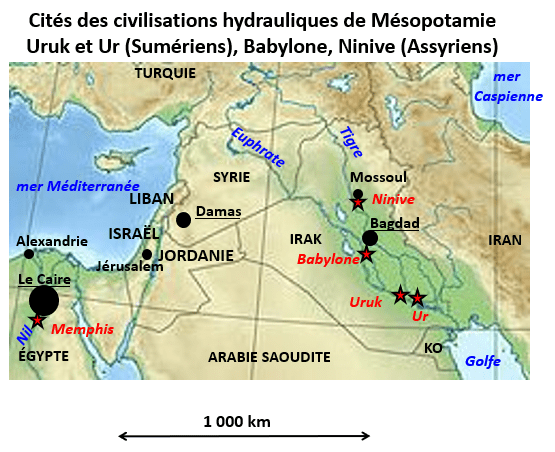
Born between the Tiger and Euphrates, this region (now Iraq) saw the birth of writing and the first cities-states thanks to the control of irrigation.
We are in a largely desert area where irrigation has been practised for about 5000 years.
Ancient Egypt
The Nile was considered a god (Hâpy). His annual floods laid down a fertile silt indispensable for the survival of the kingdom. Without the Nile, Egypt would have been only a desert and could not have transported the stone blocks to the Pyramids by canals fed by the river water.
India
The civilization of the Indus Valley (c. 2500 B.C.) has built sophisticated irrigation systems, including reservoirs, wells and complex canal networks.
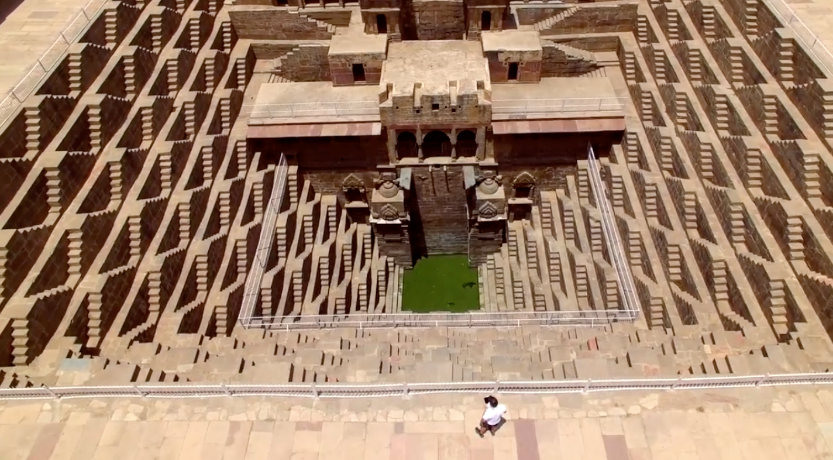
Degree wells, or baoris, were particularly remarkable, providing a sustainable water source in arid regions and demonstrating advanced engineering skills.
The Chand Baori in Rajasthan is considered one of the oldest existing degree wells. On three of its sides, it has 3,500 steps that cascade down 13 floors deep to reach a huge basin at the bottom. The fourth side has pillar corridors spread over several levels. Here we will notice the exquisite diamond-shaped geometry formed by the cascading steps on all three sides, as well as the image of Sheshasayee Vishnu resting on the serpent Ananta.
The archaeological site of Mohenjo-daro

Considered the spiritual ancestor of swimming pools and ritual baths, the Grand Bain testifies to the mastery of bitumen sealing and water supply systems of the civilization of the Indus Valley.
The cult of sources (Paganism & Celticism)
Before Christianity, natural water sources (such as fountains or resurgences) were inhabited by deities, nymphs or fairies. They threw away offerings (currency, objects) to attract favors from the gods.
The "Vouivre" and the veins of the Earth
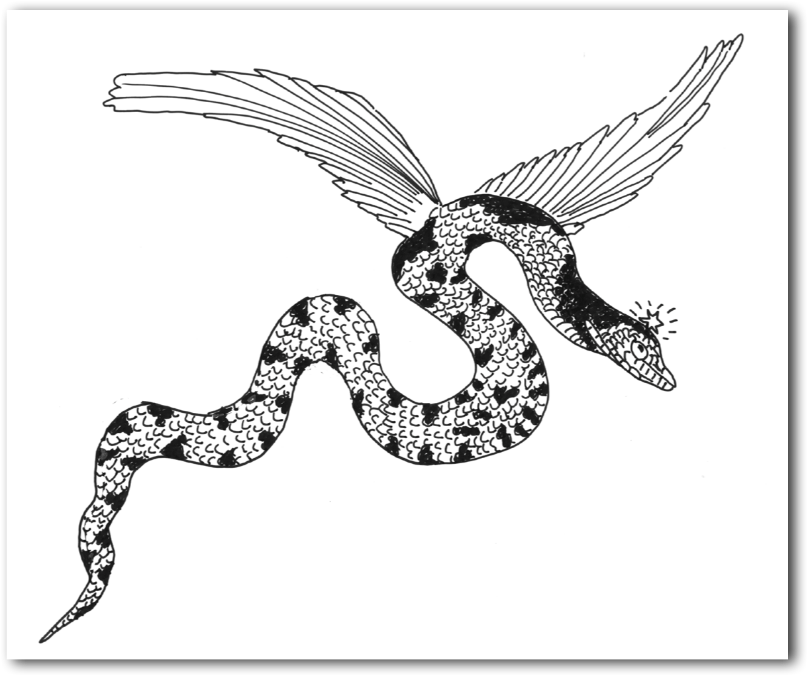
In the Celtic and medieval tradition, the underground rivers are assimilated to the Vouivre, this mythical snake or dragon that crawls under the ground.
Clearly, it can also fly
Greece
Aristotle (384 - 322 BC)

Theoretician of atmospheric and underground cycles
A great philosopher and scientist of ancient Greece, Aristotle devotes his Meteorological Treaty to the origin of water. He proposes a model where the rational mind tries to explain the invisible forces of nature.
It is the first to theorize the principle of thermal distillation (evaporation of the sun isolates fresh water and leaves salt at the bottom of the sea).
To explain the flow of rivers, he postulates that seawater and air infiltrate the mountains and condense in fresh water waves in gigantic cold caverns. This idea of the "subterranean alambic" will influence both the science and the imagination of the boogers for two millennia.
In his Meteorological treatise, written around 340 B.C., Aristotle formulates a pioneering theory to explain how fresh water originated from the sea, solving what was then one of the greatest mysteries of antiquity.
At that time, scientists asked themselves a twofold question: why does the sea never overflow when all the rivers flow there? And on the other hand, how can river water be sweet if it comes from the salty sea?
Aristotle's response is based on two distinct mechanisms, one aerial and the other underground.
The great atmospheric cycle (Natural desalination)
Aristotle is the first to understand the principle of thermal distillation. He observes that the heat of the sun evaporates surface water from the sea.
He claims that only the "soft and light" part of the water is able to rise as steam. The salt, being heavy and dense, remains at the bottom.
This fresh water vapour rises into the atmosphere, cools, condenses again into liquid (rain) and falls back to feed the Earth. He explicitly wrote: "The vaporized sea water becomes fresh water and the condensed steam no longer gives sea water".
The underground cycle (Condensation in caves)
Seawater and outdoor air penetrate the depths of the Earth through pores and large cracks.
In the basement, under the intense cold in the huge rocky caverns beneath the mountains, invisible air and sea vapours liquefy and condensate in fresh water waves.
This nascent freshwater, released from its salt through this process of filtration and underground thermal condensation, seeks an exit and flows in the form of springs at altitude to give birth to the rivers.
Rome
Greco-Roman rhabdomancy: The first wooden sticks divinatory
Practice rooted in the sacred and divinatory rituals of ancient peoples, rhabdomancy refers to the art of reading the future or discovering things hidden with a stick or wooden rod. Among the Greeks and Romans, this method lays the direct foundations of what will become the traditional sourcery much later.
Priests and diviners use specific wood twigs, often of the willow, willow or myrtle, cut according to precise rites. The practitioner holds the baguette in his hands and walks on the ground until the wood animes or bows under the influence of invisible force to designate a specific place.
Although its main use is religious to question the will of the gods, rhabdomancy is the first documented ancestor of dowsing research. It introduces the fundamental idea that a human-held plant instrument is capable of resonating with waves, flows or secrets buried in the depths of the soil, whether they are treasures, minerals or water sources.
Vitruvius (80-15 BC)

Field observer
A great Roman architect and engineer, Vitruve consecrated book VIII of his major treatise Architectura looking for water. For him, no magic: finding water requires careful observation of nature.
It lists the indicator plants (roses, willows, ivy) that betray the presence of a nearby tablecloth.
He advises to lie down on the ground, at sunrise, the chin on the ground, to spot with the naked eye the fogs and wet vapors rising from the earth, infallible sign to be dug there.
Pliny the Elder (23 - 79)

The encyclopedist of nature
Writer and Roman naturalist, Pline the Ancient compiles the entire scientific knowledge of his time in his monumental Natural History. In the book XXXI, he studies water in all its forms.
It refines Vitruve criteria by analysing the nature of the soils (the clay soil retains water, the sand gives a lighter water).
It lists sampling techniques and physical indices (savour, clarity, temperature) to assess the quality of a source before installing an aqueduct. This is the first great work of centralizing geological indices.
Feng Shui
In China, the search for water is not done in isolation: it is at the heart of Feng Shui (which literally means "wind and water").
Ancient masters used the Luo Pan (a complex geomantic compass) to map energy currents (Qi) and groundwater veins to determine the ideal location of imperial wells, houses and graves.